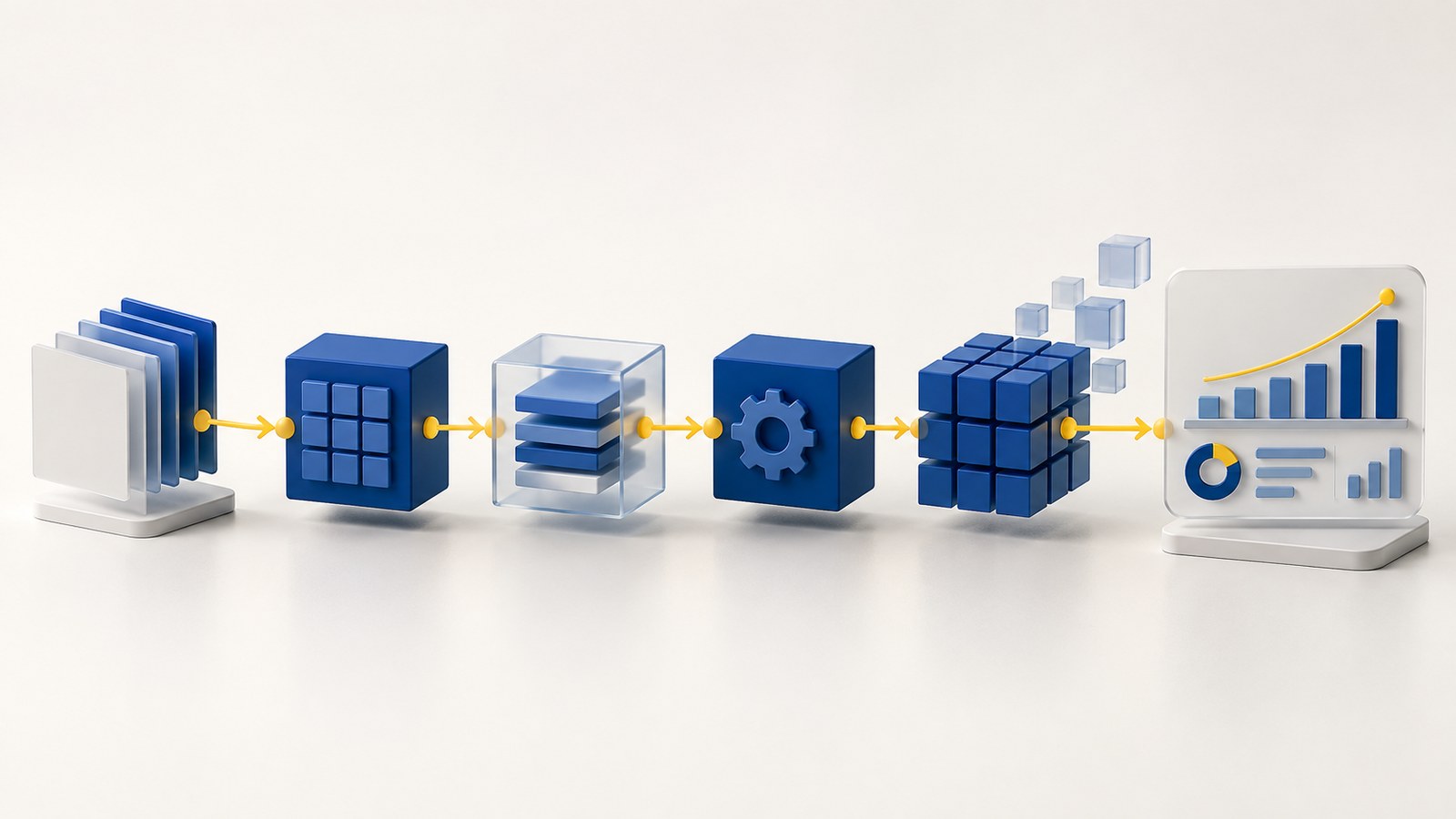
A business application is not valuable simply because it is custom-built or because it replaces a spreadsheet with a nicer screen. It earns its place when it solves a real operational problem: reducing repetitive work, preventing errors, consolidating fragmented information and giving the business better control over day-to-day operations.
The key is to start with the process, not the technology. Moving a poor process into software without redesigning it usually produces a more expensive and harder-to-change version of the same problem.
When a business application becomes justified
The need usually becomes obvious when daily work depends on multiple files, emails, notes and manual transfers of data. One team keeps information in spreadsheets, another works through email, someone else updates an ERP, and nobody is completely certain which version is authoritative.
- The same information is entered more than once.
- A task moves across several people without a clear status or history.
- Reports are assembled manually and require repeated corrections.
- Critical information exists only in email or on one employee's computer.
- The business cannot see in real time what is pending, who owns it and what happens next.
- Existing software covers most requirements but the remaining gaps create significant manual work every day.
The benefits go beyond saving time
One reliable source of data
Managing customers, requests, orders, documents or tasks through an organised system reduces the chance that teams work from conflicting information. This is a data integrity issue, not merely a convenience.
Fewer manual errors
Validation, required fields, workflow rules, automated calculations and controlled state transitions can prevent errors before they reach a customer, finance team or management.
Clear ownership and audit history
A good workflow shows who did what, when it happened and what is still pending. This matters in daily collaboration, handovers and investigations.
Automation where it makes sense
The application can generate documents, send notifications, update third-party systems through APIs, schedule recurring work or trigger actions when specific conditions are met. The aim is not to automate everything, but to remove predictable, low-value manual steps.
Operational visibility
Consistent data enables useful reporting: completion times, backlogs, conversion by stage, team workload, financial variances and recurring bottlenecks. Without reliable data, dashboards are decoration.
Custom software or an off-the-shelf product?
Not every business needs custom development. If a mature product fits the process, has a sensible cost and integrates with the existing environment, it is usually better than rebuilding something that already works.
Custom development becomes useful when the process is itself a competitive advantage, when generic products force constant workarounds or when deep integration is needed with ERP, e-commerce, CRM, payments, warehouses, APIs or internal services.
Often the strongest solution is hybrid: keep the ERP or CRM that already works and build a focused layer that connects workflows, organises information and gives users exactly the interface they need.
What must be designed correctly from the start
Application quality depends heavily on decisions that are not visible in the interface: a clean data model, roles and permissions, server-side validation, audit trails where needed, safe file handling, secure authentication, backups and clear module boundaries.
The system must also handle real exceptions. The happy path is easy; quality shows when an order is cancelled, a document is missing, a payment fails or two users change the same data.
How to know whether the investment worked
Before development begins, define a small set of measurable goals: reduce quotation time, remove duplicate entry, handle requests faster, reduce errors or improve visibility of pending work.
If we cannot describe which operation will improve and how we will measure it, it is probably too early to write code.
At Interactive Net Solutions we design and build custom web applications around real business workflows and integrate them with existing systems. When the model requires accounts, subscriptions or a multi-customer service, the same principles can be developed into a SaaS platform.